Simple Marketing Systems for Solopreneurs: Website, Blog, Newsletter & Repurposing
Here’s what I keep hearing from solopreneurs right now.
“I know I need to be more consistent with my content.” “I started a newsletter but never kept it up.” “My website is fine, I just don’t think it’s actually working.” “I have blog posts but I’m not sure anyone’s finding them.”
Sound familiar?
The thing is, none of that is a motivation problem. It’s not even a time problem, not really. It’s a systems problem. And systems are fixable.
This post is a behind-the-scenes look at what I’m actually building with clients right now. The patterns I keep seeing, what we tackle first, and how I’m thinking about the year ahead for solopreneurs who want to grow without burning out.
The Same Four Problems Keep Coming Up
I work with coaches, consultants, and service providers, mostly in Ireland and the UK, and the blockers are almost always the same.
A website that’s unclear. Not broken, not ugly. Just vague. It tries to say too much and ends up saying nothing. Visitors don’t know what to do next, so they leave.
Blog posts that exist in isolation. Good content, written with care, but no links between posts, no connection to services, no structure. It sits there and waits to be found. It usually isn’t.
A newsletter that never became a habit. Either it went out twice in January and then disappeared, or it’s sending but without any real system behind it. No welcome sequence, no lead magnet follow-up, no rhythm.
Content that gets created once and never used again. A blog post goes live. Maybe it gets shared on Instagram. Then it’s gone. Meanwhile, you’re sitting down to create more content when you already have a library of good stuff nobody’s seen.
When I see all four of these together, which is most of the time, it’s not overwhelming. It’s actually just one core issue: the pieces aren’t connected.
The Stack I'm Building With Clients in 2026
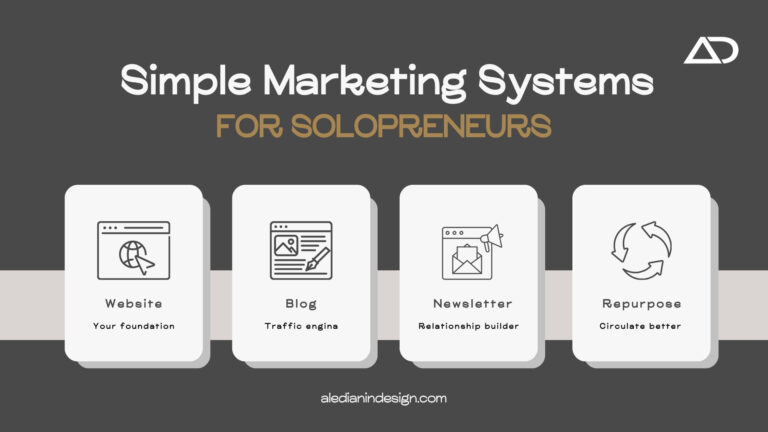
This year, I’m working around one idea: the simple systems stack.
Website / Blog / Newsletter / Repurposing
Each layer feeds the next. When one’s missing or patched together, the whole thing is less effective than it should be. Here’s what each piece actually does.
1. Website: Your Foundation
Hi, I'm a global tooltip.
This is the piece that everything else points back to. And it doesn’t need to be fancy, it needs to be clear.
What I’m fixing most often: homepages that speak to everyone, service pages that describe the process but not the outcome, and CTAs buried at the bottom of a page nobody scrolls to.
We simplify. One clear offer above the fold, copy that speaks to the person you actually want to work with, and a next step that feels obvious, not like a commitment.
A clearer website doesn’t just improve conversions. It makes every other piece of content you create more effective, because now there’s somewhere worth sending people.
2. Blog: Your Long-Term Traffic Engine
Hi, I'm a global tooltip.
A blog without a strategy is just a content archive. A blog with a strategy is one of the quietest, most consistent ways to bring in new clients, because it works while you’re doing client work.
What I’m focusing on here isn’t volume. One well-structured post a month is enough if it’s the right post, written around the right keyword, linked properly to your other content and services.
The piece most people miss is internal linking. Your blog posts should be talking to each other, and they should be pointing to your services. If they’re not, you’re leaving traffic and trust on the table.
Last year, I worked with a coach who had two years of blog posts, genuinely useful ones, but they were all isolated. No links between them. No connection to her offers. We spent one session mapping out a simple linking structure and creating one hub post to tie it together. Her organic traffic picked up within six weeks. Same content. Better architecture.
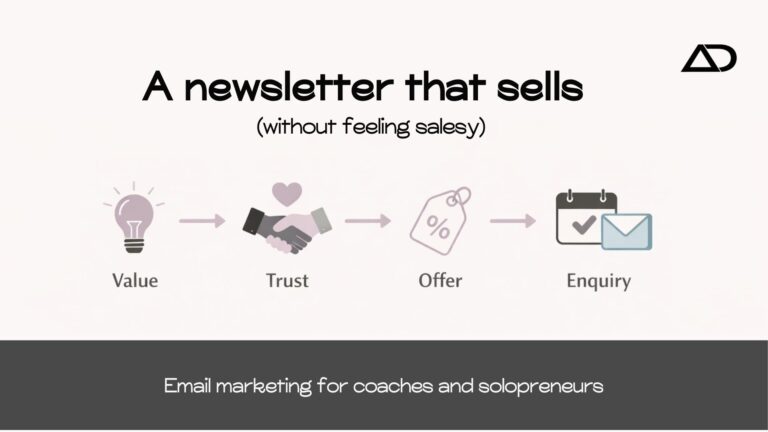
Your newsletter is where the trust gets built. But only if it goes out consistently, and only if there’s a system making that easy.
Most of the newsletter problems I see aren’t about what to say. They’re about the absence of a rhythm and a basic automation layer underneath.
What a working newsletter system looks like for a solopreneur:
A welcome sequence that does the introductions for you (2 to 3 emails, written once). A lead magnet follow-up that nurtures new subscribers automatically. A monthly email that your reader actually looks forward to, and that points back to your latest blog post or offer.
When that’s in place, your newsletter stops being the thing you feel guilty about and starts being the thing that quietly books calls for you.
One client came to me with 400 subscribers and four months of silence. We wrote a simple re-engagement sequence, three emails over two weeks. Forty-two people replied. Three booked calls. The list was never dead. It just needed a nudge.
This is the piece most solopreneurs skip, and it’s the one that changes how much time you spend on content.
The idea is simple: you’re not starting from scratch every time you need to post on LinkedIn or send a newsletter or write a caption. You’re working from what already exists.
One blog post can become your monthly newsletter, two or three LinkedIn posts, a carousel or short video script, or a talking point for a podcast or guest article.
You’re not creating more. You’re circulating better.
I use AI to speed up this part of the process, taking a finished blog post and pulling out the angles, the quotes, the frameworks that work in other formats. It’s not about replacing the thinking. It’s about removing the blank-page problem on platforms that aren’t your main focus.
I don’t come in and overhaul everything at once. That’s overwhelming for a solopreneur and usually doesn’t stick.
What actually works is starting with whatever’s most broken, fixing it properly, and then connecting it to the next layer. Sometimes that means we spend the first month on website clarity. Sometimes a client has a great website but no newsletter and that’s where we start.
The goal is always the same: a system you can maintain without it taking over your week.
For most of the solopreneurs I work with, once the stack is running, they’re spending two to three hours a month on content. Not twenty. Two to three.
How We Can Work Together Right Now
Hi, I'm a global tooltip.
There are two ways to get started.
Strategy Call A focused one-off session where we look at what you have, figure out where the gaps are, and map out exactly what to do first. You leave with a clear plan. Book a free call
Monthly Support We build and maintain the stack together. Your blog post becomes your newsletter, your newsletter gets turned into LinkedIn content, and each month the system gets a little more effective. See how monthly support works
I also have a small referral programme. If you know another solopreneur who’s been nodding along to this post, I’d love an introduction.
The solopreneurs I work best with aren’t looking for more to do. They want the things they’re already doing to actually work, and to stop starting from zero every single month.