
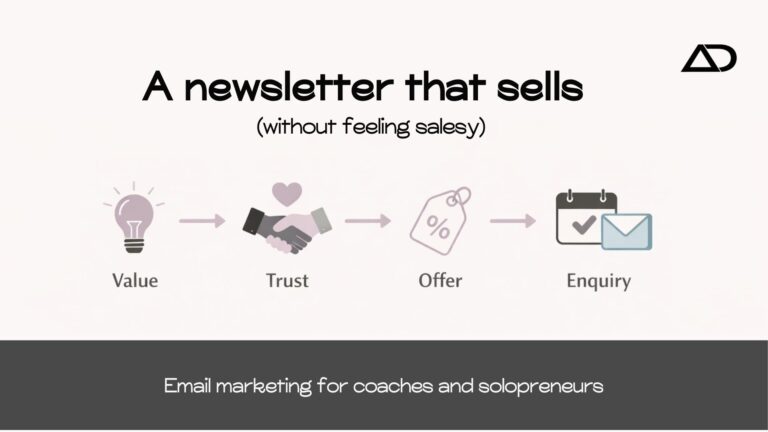
How Coaches and Solopreneurs Can Sell More Through Their Newsletter
Is your newsletter sitting there, collecting virtual dust?
You’re not the only one. A lot of coaches and solopreneurs set up an email list with the best intentions, send a couple of emails, then quietly disappear when client work gets busy or life gets loud.
But here’s the thing: if you’re building a newsletter for coaches, your email list can become one of the most consistent ways to generate enquiries and sales, without relying on social media algorithms or the pressure to post every day.
In this post, I’ll show you how to turn your newsletter into a simple sales system, using clear messaging, value-first content, smart automations, and a few easy improvements that make a real difference over time.
Why a newsletter for coaches is so powerful
You’re speaking to people who already chose you
When someone subscribes, they’re raising their hand and saying, “Yes, I want more of this.”
That matters. They’re not a scrolling stranger. They’re a warm audience you can build trust with in a much more personal way than social media allows.
Email gives you more control than social media
On social media, reach is unpredictable. Even your best post can disappear in hours.
Email works differently. People open when they’re ready. They come back to it. They search their inbox when a problem becomes urgent and they finally want help.
For coaching and high-trust services, this is exactly what you want.
It’s relationship building at scale
Most of your future clients won’t buy the first time they discover you. They need time.
A newsletter is how you stay present in a calm, consistent way, so when they’re ready, you’re the obvious choice.
If you’re also writing blog content and trying to make it work harder for you, you’ll probably enjoy 5 Reasons Your Coaching Blog Isn’t Ranking on Google (and How to Fix It) because it explains how structure and strategy help your content convert, not just “exist”.
1. Get clear on your message before you write a single email
Before templates, before tools, before subject lines, come back to two questions:
What do you want to be known for?
What problem do you solve, specifically?
Your newsletter becomes powerful when it feels consistent. If readers don’t know what your emails are “about”, they stop opening them.
A simple way to stay consistent is to choose 2–3 content pillars that match your offers. For example:
pricing and boundaries
confidence and visibility
business systems and productivity
leadership and communication
client attraction and content strategy
If you want a helpful framework for building that kind of structure, Blog Content Strategy for Coaches: How to Attract Clients (Not Just Readers) is a great companion piece, because it shows how to connect content to services without sounding repetitive.
2. Give value first, then make an offer (in a way that feels natural)
Selling through a newsletter doesn’t mean turning every email into a pitch.
The simplest approach is:
help first → invite second
Value ideas that work especially well in newsletters
a quick win your reader can apply today
a mini framework you use with clients
a behind-the-scenes story from your work
a “mistake to avoid” that saves time and stress
a short client transformation (with permission)
Then you transition into an offer by making the next step feel obvious, not forced:
“If you’d like support applying this to your business, here’s how we can work together.”
You’re not randomly selling. You’re inviting.
3. Segment your email list so it feels personal (even if your list is small)
Not everyone on your list is in the same place.
Some are new. Some are quietly checking your prices. Some love your content but still don’t know what you actually offer.
You don’t need complicated segmentation to get results. Start simple:
Segment by interest (what they signed up for)
Segment by engagement (active readers vs people who haven’t opened in a while)
Even basic tagging makes your newsletter feel more relevant, and relevance is what drives clicks and conversions.
4. Write subject lines that get your newsletter opened
If your email isn’t opened, it doesn’t matter how good it is.
You don’t need gimmicks. You need clarity and curiosity.
Subject line examples
“A simple way to get more clients without posting more”
“The one email I’d write if I was starting again”
“Quick question about your next three months”
One practical tip
Write the email first, then write the subject line last. You’ll be closer to what the email is actually doing and your subject line will sound more natural.
5. Make your call to action crystal clear
If you want the newsletter to drive sales, you need to ask for the next step.
Great CTAs for coaches and solopreneurs
book a strategy call
reply to the email
join a workshop or programme
click through to a service page
Pick one main next step per email. It increases action and reduces overwhelm.
And if you’re reading this thinking, “I know my newsletter could do more, I just don’t know how to turn it into a system,” you can book a strategy call with me and we’ll map out what to send, what to automate, and how to connect it to your offers in a way that feels calm and doable.
6. Use automations so your newsletter keeps working in the background
Automations are what turn “sending emails” into a system.
Welcome sequence (2–3 emails)
who you are
what you help with
what to expect from your newsletter
one clear next step
Lead magnet follow-up
If someone signs up for a free resource, a short follow-up sequence helps them actually use it and builds trust faster.
Re-engagement email
A simple “Are you still interested?” message keeps your list healthy and improves results long-term.
If you’re already experimenting with AI for writing or planning, you might also like Top AI Writing Tools for Solopreneurs: Work Less, Earn More, and Free Up Your Time because it supports the exact “simple systems” mindset that makes newsletter consistency easier.
7. Build trust through real stories (not perfect marketing)
People don’t buy coaching sessions. They buy trust and outcomes.
Easy story prompts to use in newsletters
what you’re noticing in your client work
a lesson you learned the hard way
a small win that mattered
a belief shift you see clients go through repeatedly
Your audience doesn’t need polished. They need honest and clear.
8. Track what’s working so you’re not guessing
You don’t need to obsess over metrics, but you do need a simple feedback loop.
Watch these metrics
open rate (subject lines + relevance)
click-through rate (interest + CTA strength)
replies (this one matters a lot for service businesses)
unsubscribes (a few are normal)
Over time you’ll see patterns, and the newsletter becomes easier to write because you’ll know what lands.
9. Use A/B testing to improve results over time
A/B testing helps you stop guessing and start learning.
What to test
subject lines
CTA wording (book a call vs reply to this email)
format (short and punchy vs longer story)
The goal isn’t perfection. It’s improving gradually, so each newsletter becomes a little more effective than the last.
10. Choosing newsletter software: MailerLite vs Mailchimp (free plans)
If you’re just starting, choosing a platform can become another excuse to delay.
You don’t need the perfect email marketing tool. You need one that helps you:
send newsletters consistently
create a sign-up form
build simple automations
track basic results
MailerLite: newer than Mailchimp, but strong where it counts
MailerLite hasn’t been on the market as long as Mailchimp, but it has strong features and a calmer interface, which many solopreneurs love.
One key benefit for people starting out is that on the free plan, you can usually set up more than one automation. That matters if you want:
a welcome sequence
a lead magnet sequence
a simple follow-up sequence
If you’re not ready to invest much yet, but you do want multiple automations running quietly in the background, MailerLite is a very practical choice.
Mailchimp: long-established and widely integrated
Mailchimp is the familiar name. It’s been around for years and integrates with lots of tools.
If you already use it, or you need a specific integration, it can be a solid option.
That said, many early-stage solopreneurs find it a bit busy. If you tend to get overwhelmed by too many settings, a simpler platform can make consistency easier.
The best platform is the one you’ll actually use
Both can work.
If you want a calmer tool with strong features and the flexibility to run a couple of automations on a free plan, MailerLite is worth a serious look. If you want a long-standing platform and you already know your way around it, Mailchimp may fit better.
Either way, the real win is not the platform. It’s the system you build around it.
Bringing it all together
A newsletter is not just something you “should do”. It’s one of the simplest ways for coaches and solopreneurs to sell consistently, because it builds trust over time.
When you focus on:
a clear message
value-first content
simple segmentation
a strong CTA
automations that support your offers
small improvements like A/B testing
…your newsletter becomes a sales channel that doesn’t rely on constant visibility.
Start small. One email a month is enough to build momentum. What matters is consistency, clarity, and a system you can actually sustain.
Want help making your newsletter actually sell?
If your newsletter is sitting in the background and you want it to become a steady source of enquiries, I can help.
In a quick strategy session, we’ll map out:
what your newsletter should focus on
what to send (and how often)
which automations to set up first
how to connect it to your website and offers
If you want someone to build the whole thing into a monthly rhythm, where your blog post becomes your newsletter and then turns into LinkedIn content too, you’ll love my Monthly Content Package. It’s designed for solopreneurs who want consistent visibility without living inside content creation.
Your list is already an asset. Let’s make it work like one.
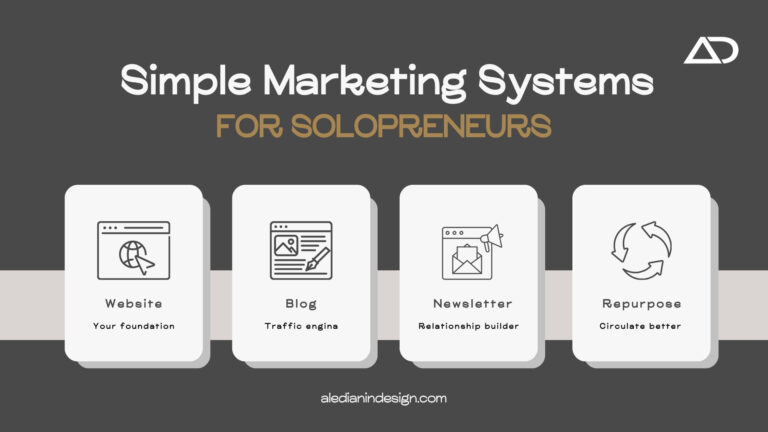
How Coaches and Solopreneurs Can Sell More Through Their Newsletter Is your newsletter sitting there, collecting virtual dust? You’re not the only one. A lot of coaches and solopreneurs set up an email list with the best intentions, send a…

Blog Content Strategy for Coaches: How to Attract Clients, Not Just Views If you’ve been blogging consistently but still not seeing client enquiries, you’re not alone. Many coaches create thoughtful blog posts, but without a clear strategy, those posts often…